

Titanium Nuts Uncovered: The Small Hardware Making a Huge Impact!
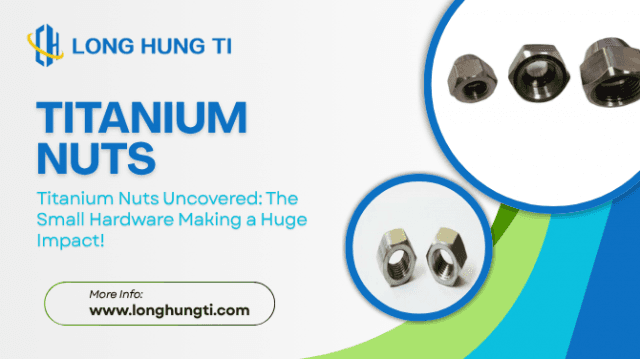
In the world of precision fasteners, titanium nuts might seem like humble components, but their impact on modern engineering is nothing short of revolutionary. At Shen Zhen Long Hung Titanium Ltd., we've witnessed firsthand how these small but mighty fasteners have transformed industries ranging from aerospace to medical implants. While often overlooked in favor of their more visible counterparts, titanium nuts play a critical role in ensuring structural integrity, longevity, and performance in some of the most demanding applications imaginable.
The journey of titanium nuts from niche specialty items to mainstream engineering solutions tells a fascinating story of material science advancement. Unlike traditional steel nuts, titanium versions offer an unparalleled combination of strength, light weight, and corrosion resistance that makes them indispensable in environments where failure is not an option. From the depths of the ocean to the vacuum of space, titanium nuts provide reliable fastening solutions that stand the test of time and extreme conditions.
Why Titanium Nuts Are Changing the Game?
The Weight-to-Strength Revolution
One of the most compelling advantages of titanium nuts lies in their exceptional strength-to-weight ratio. Weighing approximately 45% less than steel equivalents while offering comparable tensile strength, these fasteners have become game-changers in weight-sensitive applications. In the aerospace industry, for instance, every gram saved translates to significant fuel efficiency gains over an aircraft's lifetime. Our engineers at Shen Zhen Long Hung Titanium Ltd. have calculated that replacing just the nuts in a commercial airliner's critical assemblies can reduce overall weight by hundreds of pounds, resulting in millions of dollars in fuel savings over the aircraft's service life.
The marine industry has similarly benefited from this weight advantage. Boat builders and offshore platform designers increasingly specify titanium nuts for rigging and structural connections, where reducing top weight improves stability and performance. Even in automotive racing, where milliseconds count, teams are switching to titanium fasteners throughout their vehicles to shave precious weight without compromising safety or durability.
Corrosion Resistance That Defies Environments
Perhaps the most celebrated property of titanium nuts is their incredible corrosion resistance. Unlike steel fasteners that require protective coatings and regular maintenance to prevent rust, titanium naturally forms a protective oxide layer when exposed to oxygen. This passive film makes titanium nuts virtually immune to:
- Saltwater corrosion in marine applications
- Chemical degradation in processing plants
- Atmospheric weathering in coastal environments
- Galvanic corrosion, when paired with dissimilar metals
At our testing facilities in Shenzhen, we've subjected titanium nuts to accelerated salt spray tests equivalent to 50 years of marine exposure. The results consistently show that properly manufactured titanium fasteners maintain their structural integrity and thread quality even after decades of simulated service. This longevity makes them particularly valuable for offshore oil platforms, desalination plants, and other installations where maintenance access is difficult or expensive.
Temperature Performance Beyond Ordinary Metals
Titanium nuts excel in temperature extremes that would compromise most other fasteners. They maintain their mechanical properties from cryogenic temperatures up to 600°F (315°C), making them ideal for:
- Jet engine components
- High-performance exhaust systems
- Cryogenic storage tanks
- Industrial furnaces and heat exchangers
This thermal stability stems from titanium's unique atomic structure and high melting point (3,034°F or 1,668°C). Unlike aluminum fasteners that weaken at elevated temperatures or steel that becomes brittle in extreme cold, titanium nuts provide consistent clamping force across a remarkably wide temperature range.
The Manufacturing Precision Behind Quality Titanium Nuts
Material Selection and Verification
At Shen Zhen Long Hung Titanium Ltd., we begin every production run with rigorous material certification. Our titanium nuts are manufactured from aerospace-grade alloys (primarily Grade 2 and Grade 5 titanium) that undergo:
- Spectroscopic chemical analysis
- Ultrasonic testing for internal defects
- Mechanical property verification
- Traceability documentation
This meticulous approach ensures that every batch of raw material meets the strictest industry standards before machining begins.
Precision Machining Techniques
Creating high-performance titanium nuts requires specialized machining expertise. Titanium's strength and low thermal conductivity present unique challenges that demand:
- CNC machines with rigid constructions
- Advanced cutting tool materials
- Optimized coolant strategies
- Precision thread rolling rather than cutting
Our manufacturing team has developed proprietary processes that produce threads with superior surface finish and dimensional accuracy. This attention to detail results in titanium nuts that provide smoother engagement, more consistent torque values, and longer service life than conventionally machined alternatives.
Quality Control That Leaves Nothing to Chance
Every titanium nut leaving our facility undergoes multiple inspections, including:
- Dimensional verification with optical comparators
- Thread pitch diameter measurements
- Surface finish analysis
- Proof load testing
- Salt spray testing for corrosion resistance samples
We maintain complete traceability throughout the production process, allowing us to provide material certifications and test reports with every shipment. This commitment to quality has made Shen Zhen Long Hung Titanium Ltd. a trusted supplier to industries where fastener failure is not an option.
Applications Transforming Industries
Aerospace and Defense
In aircraft construction, titanium nuts secure critical components while reducing weight and eliminating corrosion concerns. They're particularly valued for:
- Engine mounts and nacelles
- Landing gear assemblies
- Airframe structural connections
- Satellite and spacecraft components
The Boeing 787 Dreamliner, for example, uses thousands of titanium fasteners to join its composite airframe sections, taking advantage of titanium's compatibility with carbon fiber materials.
Medical Device Innovation
The biocompatibility of titanium has made titanium nuts essential in medical implants and surgical tools. They're commonly used in:
- External fixation devices
- Prosthetic limb assemblies
- Dental implant systems
- Surgical robot components
Unlike stainless steel, titanium doesn't interfere with MRI scans and rarely causes allergic reactions, making it ideal for long-term implantation.
High-Performance Automotive
From Formula 1 cars to luxury automobiles, titanium nuts provide:
- Weight reduction for better acceleration and handling
- Corrosion resistance in harsh environments
- Thermal stability in engine compartments
- Aesthetic appeal for visible fasteners
Many high-end manufacturers now offer titanium fastener upgrades that appeal to performance enthusiasts and collectors.
The Future of Titanium Fastening Technology
As material science advances, we're seeing exciting developments in titanium nut technology:
- Nanostructured surface treatments for improved wear resistance
- Hybrid fastening systems combining titanium with composite materials
- Smart nuts with embedded sensors for load monitoring
- Additive manufacturing techniques for custom geometries
At Shen Zhen Long Hung Titanium Ltd., our R&D team is actively working on next-generation titanium nuts that will push the boundaries of performance even further. From ultra-high-strength alloys to self-locking designs optimized for vibration resistance, the future of titanium fastening looks brighter than ever.
While they may be small in size, titanium nuts are making an enormous impact across countless industries. Their unique combination of strength, lightness, and corrosion resistance solves engineering challenges that other fasteners simply can't address. As technology advances and industries continue to demand higher performance from their components, we expect the adoption of titanium nuts to accelerate across even more applications.
At Shen Zhen Long Hung Titanium Ltd., we're proud to be at the forefront of this fastening revolution. With our precision manufacturing capabilities, rigorous quality standards, and deep technical expertise, we're helping engineers around the world build better, more reliable, and longer-lasting products—one titanium nut at a time.
Whether you're designing the next generation of aircraft, medical devices, or high-performance vehicles, consider how titanium nuts could improve your project's performance and longevity. Contact our engineering team today to discuss your specific requirements and discover why so many industry leaders trust our titanium fastening solutions.
FAQs
1. What makes titanium nuts superior to steel nuts in critical applications?
Titanium nuts offer three key advantages over steel:
- 45% lighter weight with comparable strength
- Natural corrosion resistance (no rust or galvanic corrosion)
- Biocompatibility (safe for medical and marine use)
They're ideal for aerospace, medical, and marine applications where failure isn't an option.
2. Can titanium nuts handle extreme temperatures?
Absolutely! Titanium nuts maintain performance from:
- Cryogenic temperatures (-300°F/-184°C)
- Up to 600°F (315°C) continuous servic
- This makes them perfect for jet engines, exhaust systems, and cryogenic storage.
3. Are titanium nuts worth the higher cost compared to steel?
While titanium nuts cost more upfront, they provide:
- 50+ year lifespan in corrosive environments
- Zero maintenance (no protective coatings needed)
- Weight savings that reduce fuel/energy costs
For critical applications, they're actually more cost-effective long-term.
4. How do you prevent galling when installing titanium nuts?
We recommend:
- Using anti-galling compounds during assembly
- Slow installation speeds to reduce friction heat
- Precision-machined threads (like ours) that minimize metal-to-metal contact
5. Can I get custom-designed titanium nuts for specialized applications?
Yes! Shen Zhen Long Hung Titanium Ltd. offers:
- Non-standard sizes (from M1.6 to M100+)
- Special thread profiles (UN, metric, aerospace)
- Custom coatings (anodized, PVD, or lubricated)
- Low-volume prototyping for R&D projects