

Custom Titanium Screw: Precision and Strength for Demanding Applications
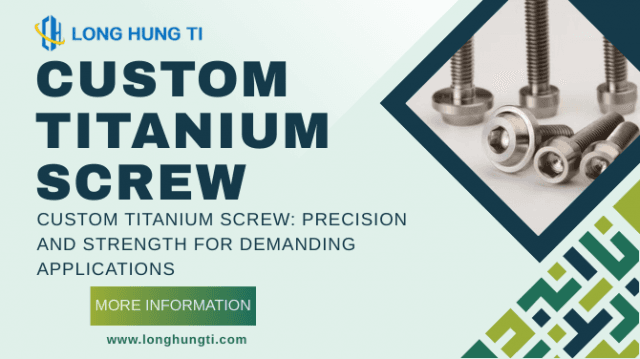
In an era where products are expected to be lighter, stronger, cleaner, and more reliable, the humble fastener has emerged as a pivotal design variable rather than mere hardware. When standard, off-the-shelf screws start dictating your design choices—or when weight, corrosion, or assembly repeatability threaten to bottleneck performance—customization becomes a powerful lever. A Custom Titanium Screw, thoughtfully specified and expertly manufactured, can unlock measurable gains throughout your product lifecycle: from prototyping agility and assembly yield to long-term durability and serviceability. At Shen Zhen Long Hung Titanium Ltd., we help engineering and manufacturing teams turn fasteners into competitive advantages by aligning material, geometry, process, and quality controls with the realities of your application.
Moreover, the rationale for titanium is compelling. It offers a distinctive strength-to-weight ratio, excellent corrosion resistance in many challenging environments, and non-magnetic behavior that benefits sensitive equipment. However, the rationale for customizing a titanium screw goes further. By tailoring head profile, drive type, thread form, tolerances, and surface condition—together with the right titanium grade and manufacturing route—you can balance strength, stiffness, friction, and cost with unusual precision. Consequently, a Custom Titanium Screw becomes not only a connector but also a system-level performance enabler.
Why titanium, and why now?
Titanium has long been an aerospace and medical staple, yet its advantages now permeate EVs, robotics, high-end consumer devices, marine systems, and semiconductor equipment. Weight savings cascade into energy efficiency, faster actuation, and lower inertial loads. Meanwhile, consistent clamping through temperature swings, exposure to cleaning agents, or high vibration reduces maintenance and field failures.
- Strength-to-weight: Ti-6Al-4V (Grade 5) can rival many alloy steels at roughly 60% of the density. Therefore, you can achieve high clamping force with less mass.
- Corrosion resistance: A stable oxide film protects titanium in saline, humid, and many oxidizing environments that challenge stainless steels. Thus, it's a smart choice for marine and coastal deployments, chemical process skids, and outdoor devices.
- Non-magnetic and clean: In labs, MRI-adjacent environments, and sensitive instrumentation, titanium's non-magnetic behavior and cleanability are decisive.
- Temperature range: Titanium maintains useful properties at low and moderately high temperatures, supporting applications from cryogenic handling to under-hood components.
However, not all titanium fasteners are equal, and not all screws solve the same problem. That is precisely where a Custom Titanium Screw adds value: it lets you define exactly what matters—performance, assembly behavior, documentation, and cost—instead of bending your design to a catalog part.
What is a Custom Titanium Screw?
In practical terms, a Custom Titanium Screw is a titanium fastener engineered to your application's specific requirements. It incorporates:
- The right alloy grade (e.g., commercially pure Grade 2 for corrosion/formability; Grade 5 for high strength; ELI Grade 23 for toughness and biocompatibility)
- Tailored head geometry and drive type to fit space claims and installation torque
- Optimized threads (pitch, class of fit, rolled vs. cut, lead-in geometry) to stabilize torque-tension and resist galling
- Purposeful surface condition (finish, lubrication, or coating) to manage friction and prevent seizing
- Documentation, inspection, and traceability to satisfy your quality framework and industry norms
Furthermore, thoughtful customization frequently consolidates adjacent hardware—washers, spacers, locking features—into a single part, simplifying your bill of materials and boosting assembly throughput.
When does customization pay off?
Customization makes sense whenever standard parts force undesirable compromises. Typical triggers include:
- Tight envelopes or clearance zones where head height, drive access, or thread engagement is constrained
- Weight targets that cascade through the system (e.g., extending UAV flight time or improving EV range)
- Corrosive or hygienic environments where titanium's passive film and cleanability shine
- High vibration or cyclic loading in which thread strategy and surface condition reduce torque scatter and fatigue
- Regulatory demands for traceability, lot control, and validated torque/preload procedures
- Automation plans requiring consistent pick-and-place features, drive types that prevent cam-out, or pre-applied patches
If any of these describe your situation, a Custom Titanium Screw allows you to tune the fastener to your assembly's physics rather than the other way around.
Grade choice should reflect your primary constraints:
- Grade 2 (commercially pure): Excellent corrosion resistance and formability; suited for marine fixtures, process equipment, and where extreme strength is not the priority.
- Grade 5 (Ti-6Al-4V): High strength at low mass; a common choice for structural fasteners in aerospace, motorsports, and performance consumer products.
- Grade 23 (Ti-6Al-4V ELI): Enhanced toughness and biocompatibility; often specified for medical devices and critical components subject to impact or low-temperature operation.
Therefore, your Custom Titanium Screw should begin with a clear articulation of operating stress, temperature, environment, and assembly method, which will quickly narrow the grade selection.
CNC Machining
- Advantages: Complex geometries, rapid iteration, precise tolerances, low-to-mid volumes
- Considerations: Chip control and heat management are critical for titanium; tool paths should protect surface integrity
Cold heading plus secondary machining
Advantages: Efficient for higher volumes; improved grain flow and thread rolling improve fatigue; lower per-piece cost after tooling
Considerations: Upfront tooling investment; geometry must be compatible with heading
Thread rolling
Advantages: Forms threads by displacement rather than cutting, yielding work-hardened flanks and rounded roots; boosts fatigue life and surface finish
Considerations: Requires suitable material condition and precise control of blank diameter and surface
Additive manufacturing (AM), selectively used
Advantages: Complex internal features, weight-optimized lattices, integrated venting
Considerations: Post-processing, surface finishing, and inspection rigor are essential, often combined with machining for critical surfaces
Applications where custom titanium fasteners enable better design
- Aerospace and UAVs: Every gram matters; temperature swings and vibration demand consistent preload and fatigue resistance.
- Medical and life sciences: Biocompatibility, sterilization resilience, and non-magnetic behavior are crucial; documentation and traceability are mandatory.
- Marine and offshore: Chloride-rich environments call for corrosion resistance; long service intervals benefit from durable finishes and locking features.
- EVs, e-bikes, and motorsports: Lightweight strength improves responsiveness and efficiency; repeatable torque promotes safety and serviceability.
- Semiconductor and vacuum: Vented screws and clean finishes prevent virtual leaks; low-outgassing materials and controlled surface prep protect process stability.
- Precision instrumentation and robotics: Non-magnetic and low-mass fasteners aid sensitive sensors and high-speed actuators; optimized drives support automated assembly.
Common pitfalls—and how to avoid them
- Assuming any titanium grade will do: The wrong grade can compromise strength or manufacturability. Align grade with load, environment, and regulatory needs.
- Neglecting friction control: Without a defined finish and lubricant, torque scatter will undermine preload. Validate torque on the final condition.
- Overlooking galvanic effects: Dissimilar material pairs need isolation in wet environments.
- Cutting threads where rolling is feasible: Rolled threads often deliver superior fatigue performance and consistency.
- Modifying late: Waiting until DV/PV to address fastener issues can lock in cost and schedule risks. Engage early.
How Shen Zhen Long Hung Titanium Ltd. partners with you
We believe that clarity and collaboration reduce risk. Accordingly, our process typically includes:
- Requirements capture
- Use-case, environment, and performance targets
- Head/drive preferences, envelope constraints, and assembly method
- Documentation and inspection needs
- Design-for-manufacture (DFM) review
- Grade selection and process route (machining vs. heading + rolling)
- Thread strategy, tolerances, and surface condition
- Galvanic and friction considerations
- Prototyping and validation
- Pilot lots with agreed inspection plans
- Torque/preload testing under as-built conditions
- Iterations to close gaps before production tooling
- Production and quality control
- Lot traceability, certifications, and packaging standards
- Pre-applied features and labeling for line-side efficiency
- Ongoing SPC or capability studies as required
With this approach, your Custom Titanium Screw transitions from concept to repeatable production with fewer surprises.
A note on sustainability
Beyond performance, titanium's lifecycle benefits matter. Weight reduction supports lower energy consumption, while corrosion resistance cuts replacement and waste. Additionally, designing a single, multi-functional Custom Titanium Screw in place of multiple parts reduces inventory and packaging. Although titanium refining is energy-intensive, strategic use where it displaces heavier or failure-prone hardware can contribute positively to sustainability targets.
Looking ahead
This introduction sets the stage for deeper dives into torque-tension modeling, surface engineering for galling control, and case studies across industries. In the meantime, if your assemblies are constrained by fastener weight, corrosion, clearance, or inconsistent torque, it is time to consider a Custom Titanium Screw designed for your exact conditions. With informed choices at the outset—grade, geometry, thread strategy, and finish—you can secure predictable performance, reduce assembly variability, and elevate your product's value proposition.
FAQ
- What exactly is a Custom Titanium Screw?
A Custom Titanium Screw is a titanium fastener engineered to your specified geometry, material grade, surface finish, and documentation needs. You define head/drive type, thread details, tolerances, coatings, and features so the screw delivers the required performance and assembly behavior. - Which titanium grade should I choose?
It depends on your priorities. Grade 2 offers top-tier corrosion resistance and formability; Grade 5 (Ti-6Al-4V) provides high strength at low mass; Grade 23 (ELI) is favored for toughness and biocompatibility. Specialized grades address niche corrosion or forming needs. A brief requirements review typically pinpoints the best fit. - How do titanium screws compare in strength to steel?
Grade 5 titanium fasteners can approach the absolute strength of many high-grade steels while weighing significantly less. The trade-offs include a lower modulus of elasticity and different friction behavior, which should be addressed in joint design and torque validation. - How can I prevent galling with titanium threads?
Use rolled threads when feasible, control surface finish, and apply lubricants or coatings (e.g., MoS2-based dry films). Pairing with compatible nuts/inserts or using isolation materials helps. Most importantly, validate torque on the exact finish and lubrication that will be used in production. - Can I color code titanium screws?
Yes. Anodizing can create stable colors for identification and assembly control. However, anodizing can influence friction; therefore, you should confirm torque settings with the anodized finish. - What torque should I use for a Custom Titanium Screw?
Torque depends on desired preload, nominal diameter, and the friction conditions determined by finish and lubrication. Establish torque (or torque-angle) via testing with the as-supplied fastener and mating materials. Avoid reusing torque values from different finishes. - Are titanium screws suitable for carbon fiber and aluminum assemblies?
Yes, but manage galvanic coupling. Use insulating washers, sleeves, barrier coatings, or compatible inserts to prevent galvanic corrosion in wet environments. - What environments are not ideal for titanium?
Titanium is not recommended in strong reducing acids or fluoride-containing media (such as hydrofluoric acid), which compromise its oxide layer. Where necessary, consider protective measures or alternative materials. - What manufacturing methods are available?
We offer precision CNC machining for complex or low-volume parts, cold heading plus secondary machining for higher volumes, and thread rolling for improved fatigue. In select cases, additive manufacturing is combined with machining for specialized features. - How do custom features affect cost and lead time?
Customization introduces non-recurring engineering (NRE) and may require tooling for heading. Nevertheless, it often consolidates parts, stabilizes torque, and improves assembly yield, reducing the total cost of ownership. Lead time depends on alloy availability, process route, and finishing. - Can Shen Zhen Long Hung Titanium Ltd. provide documentation and traceability?
Yes. We can supply material test reports, inspection records, lot traceability, and tailored quality packages (e.g., PPAP or FAI) as required by your program and industry. - Do you support prototypes and small runs?
Absolutely. We routinely deliver pilot lots and engineering samples to validate geometry, finishes, and torque/preload before scaling. - What information do you need to quote quickly?
Please share application environment, size, and thread details, head/drive preference, target load and torque strategy, surface finish or coating needs, estimated annual usage, delivery cadence, and required documentation. This enables a precise, options-based proposal.